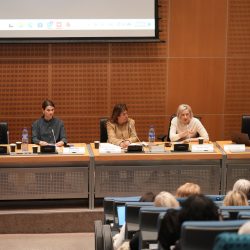
At the end of March, EPLO was invited to speak at the conference ‘Gender Budgeting in the New EU Multiannual Financial Framework: Making Budgets work for Gender Equality and Women’s Human Rights in Europe’, organised by the European Gender Budgeting Network in collaboration with the Cyprus Gender Budgeting Platform and the Foundation FIMONOI. The conference was held under the patronage of the Cyprus Presidency of the Council of the EU 2026.
EPLO contributed to the panel ‘From commitment to action: Putting gender equality and social investments at the core of the next EU budget’ with a focus on the external dimensions of the MFF. This post outlines some of the key points.
Important gender targets have been dropped in the Commission’s MFF proposal, in favour of a – to date largely undefined – gender mainstreaming approach. The specific targets that were firmly anchored in the current NDICI-Global Europe regulation and linked to the Gender Action Plan (GAP) III are no longer part of the Global Europe proposal for external action. In their place, the proposal is left with an approach that lacks clear targets, ringfencing, or transparent accountability mechanisms.
Gender Equality Commitments Are Losing Ground
The EU has done significant work in embedding gender equality in its external action, and its Women, Peace and Security (WPS) policy is strong on paper. But the work carried out under these policies remains critically underfunded, and has become increasingly under threat. Spaces and resources for women’s rights and gender equality in fragile and conflict-affected settings are shrinking while women human rights defenders and peacebuilders face a massive global backlash. Their work is becoming more dangerous, and risks being discontinued entirely in many contexts.
This matters because security and defence are deeply gendered policy fields. According to new UN data, civilian casualties among women and children quadrupled in the most recent two-year reporting period, and conflict-related sexual violence increased by 87% over the same timeframe. This is happening against a backdrop of increased worldwide militarisation. But sustainable, human-centered security cannot be achieved without gender-responsive conflict prevention. International security is a policy field where resource allocation shapes who is protected, who participates, and whose experiences are recognised. Therefore, now is certainly not the time to back down from the EU’s commitments to the WPS agenda, but rather the moment to strengthen them significantly.
The EU’s external action is currently undergoing a major reshuffling of priorities with serious implications both for gender equality in conflict-affected contexts and for the implementation of the WPS agenda. Foreign policy is being increasingly aligned with internal objectives around competitiveness, defence, and resilience. The commercial and private sector focus of the EU’s Global Gateway project also raises the need for a clear plan to ensure these investments are designed and implemented in gender- and conflict-sensitive ways. While the Commission proposal centers flexibility to adapt to upcoming challenges, this flexibility must not become a mechanism through which politically salient priorities such as migration control, border management, and short-term economic interests may crowd out continued investment in conflict prevention and gender equality.
For EPLO, meaningfully mainstreaming gender budgeting in the next MFF requires aligning the EU’s budget with its WPS agenda. This approach is grounded in decades of research and field experience across our membership which consistently demonstrates that:
- The meaningful participation of women in peace processes produces agreements that are significantly more durable than those negotiated exclusively by men;
- Psychosocial support for communities affected by conflict-related sexual violence enables survivors to rebuild their lives and become agents of change;
- Programmes engaging men on trauma, positive masculinity, and accountability generate measurable reductions in domestic and gender-based violence, and in some contexts, reduce the risk of radicalisation.
Across regions, supporting gender equality and women’s rights correlates with more peaceful, more democratic, and more stable societies.
ODA funding to women’s rights organisations (WROs) is already highly limited, and EU and member state support has dropped to new lows in recent years. However, the EU could make a significant impact by funding these organisations whose work at the grassroots level has shown to have made a transformative difference. The evidence is consistent that flexible, core funding and well-designed, adequately funded grants for WROs in conflict-affected contexts, for example through women’s rights funds or consortiums, allows these organisations to sustain their important work which can help create conditions for dialogue, and lay the foundations for durable peace. There is an underexplored potential for the EU to tap into to generate greater return for its funding.
There is also a question of what happens in the EU’s absence. When funding to WROs is cut and feminist civil society loses support, the spaces are filled by other actors, often working in active opposition to the values the EU is committed to upholding.
Turning Commitments into Budget Priorities
There are a few ways how the EU can safeguard this important work in the next budget:
- By restoring gender targets in the next framework for external action: at minimum, 20% of actions with gender equality as a principal objective, and 85% of actions with gender equality as either a principal or significant objective.
- By explicitly linking the Global Europe instrument to the targets in the current GAPIII, and later the forthcoming GAP IV, as was done with the current NDICI-GE framework for coherence between policy commitments and spending decisions.
- By clearly defining enforceable objectives and indicators: the performance framework must be sufficiently precise to ensure that women’s rights and gender equality in fragile contexts cannot be reclassified when political priorities shift.
- By supporting civil society and locally led peacebuilding initiatives by WROs with sustained, long-term, flexible and core funding that allows them to plan, build trust, and carry out the work that other actors cannot do.
Supporting women’s rights and gender equality in fragile and conflict-affected settings saves lives and advances peace. It is an evidenced, cost-effective, and strategically sound investment.
Author: Marie Lena Groenewald