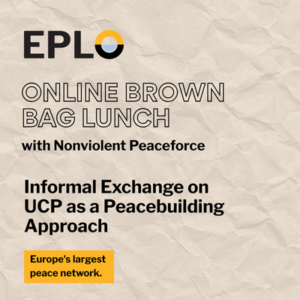
On March 11, EPLO hosted an online Brown Bag Lunch session with Nonviolent Peaceforce on their brief Peacebuilding is Possible in Emergency Contexts: Unarmed Civilian Protection (UCP) as a Peacebuilding Approach. This brief seeked to address misconceptions around the role of peacebuilding methods in crisis management and the direct protection of civilians, as well as around the (non)-linearity of the Humanitarian-Development-Peace (HDP) nexus. Based on examples from Ukraine, the Philippines and South Sudan, this brief showcases how local actors have been able to protect civilians and begin or sustain peacebuilding efforts in the midst of insecurity, through protective presence, relationship-building, and inclusive engagement.
In this virtual Brown Bag Lunch discussion, Lesley Connolly, Regional Policy and Advocacy Manager for Nonviolent Peaceforce, presented the brief and examples of how to connect peacebuilding and humanitarian work in practice. She also reflected on the challenges of siloed policy frameworks and funding streams, at EU level and beyond.
Lesley Connolly is Regional Policy and Advocacy Manager for Nonviolent Peaceforce, based in South Africa. She previously worked for several international peace and security organisations including the Life & Peace Institute, African Center for the Constructive Resolution of Dispute (ACCORD) and the International Peace Institute (IPI). She has written extensively on peacekeeping, peacebuilding and sustaining peace within the United Nations and African Union policy spaces.
Nonviolent Peaceforce (NP) is a protection NGO whose approach straddles humanitarian assistance and peacebuilding. Since 2002, NP’s mission has been to protect civilians in violent conflicts through unarmed strategies, build peace side-by-side with local communities, and advocate for the wider adoption of these approaches to safeguard human lives and dignity. NP has active programs in nine countries across four continents.